The Story of Christ Catholic Church: A Free Catholic Movement
ST. WILLIBRORD STUDIES IN CHURCH HISTORY
By Archbishops Karl Hugo Prüter and Brian Ernest Brown, CWC
All rights reserved. This book or any portion thereof may not be reproduced or used in any manner whatsoever without the express written permission of the publisher except for the use of brief quotations in a book review.
Colossians 1:15-20
He is the image of the invisible God, the firstborn over all creation. For by him all things were created: things in heaven and on earth, visible and invisible, whether thrones or powers or rulers or authorities; all things were created by him and for him. He is before all things, and in him all things hold together. And he is the head of the body, the church; he is the beginning and the firstborn from among the dead, so that in everything he might have the supremacy. For God was pleased to have all his fullness dwell in him, and through him to reconcile to himself all things, whether things on earth or things in heaven, by making peace through his blood, shed on the cross.
PREFACE
The Remnants of Christ Catholic Church of the Americas and Europe
If truth be told, there are several remnants of Christ Catholic Church of the Americas and Europe throughout the world and each of them in their own distinct way are connected with Archbishop Karl Hügo Rehling Prüter’s lifelong ministry within the Autocephalous Sacramental Movement. Christ Catholic Church Archdiocese of the Prince of Peace is one such continuing ministry and is the most intimately connected of all.
True to the practice of my predecessor I have intentionally left some things out of this historical account mainly to protect the innocent and perhaps some of the guilty too. The ministry that is Christ Catholic in association has spanned almost 100 years and across several countries and continents. That’s a lot of history and as with every group in the world, when people are involved, unraveling the truth of the historical events of the organization is often subjective and always confusing. I have tried to offer the facts as they have already been publicized by Archbishop Karl Prüter and have attempted to give an accurate, if focused, account of our shared history together since 2003.
The Most Rev. Brian Ernest Brown, CWC
Archbishop Emeritus, Christ Catholic Church Archdiocese of the Prince of Peace
Abbot General of the Sacramental Community of the Coworkers of Christ
April 1, 2025 Feast of Saint Martin of Westwood – Fayetteville, Arkansas
The following account of the history of Christ Catholic Church up until 2003 is taken from several different sources, all written by Archbishop Karl Prüter himself:
The Old Catholic Church
The Story of Christ Catholic Church (All Five Editions)
The Blue Jellybean, Hedy Lamarr, and We Don’t Eat Negroes
His personal journals and writings have also been utilized when appropriate.
Let us begin at the beginning…
CHAPTER ONE
The Free Catholic Movement and Congregational Influence
Excerpt from The Old Catholic Church 2006
In the 1930’s Old Catholics began to do work among the Congregational Christian Churches, with surprising success and long-range effects. At first glance, this would have seemed an unlikely field for Old Catholic missionary efforts. But to those familiar with Congregational history, it was less of an evangelistic effort than a call to return to the catholic heritage of the Pilgrim Fathers.
The early Congregationalists were Christocentric, and their worship centered around the Blessed Sacrament. Their devotion to the Sacrament grew directly out of the fact that it had been specifically commanded by our Lord Jesus Christ. In fact, their entire church life was a simple attempt to put into effect what Christ willed for them as individuals and as a congregation. However, without the episcopacy they quickly fell away from their catholic doctrine and practices. In the early nineteenth century, the Unitarian Movement had made deep inroads in to Congregationalism; before the end of the century, almost every vestige of Catholicism had disappeared.
It was the early meetings of the Ecumenical Movement that sparked the revival of the Catholic heritage in Congregationalism. The publication of the General Councils Book of Worship for Free Churches and Karl Prüter’s A Divine Liturgy for Free Churches pointed the way toward Catholic revival. A small but significant number of churches began to celebrate Mass on a weekly basis using either the Divine Liturgy for Free Churches, The Anglican Book of Common Prayer, the Old Catholic Missal and Liturgy edited by Archbishop Mathew and Archbishop Gul in 1909.
Orders also became a matter of concern. A few ministers sought and received Catholic ordinations from American Old Catholic bishops. Bishop Howard Mather served the Order of Antioch while functioning as a Congregational pastor in a number of Congregational Churches, including the historic Church at Sheffield, Massachusetts. Often they met with serious opposition, but in most instances the congregations regarded what was happening as a revival of true Congregationalism. Those in the Liturgical Movement had considerable support from influential persons in the Congregational Churches. Dr. Raymond Calkins lead the way by affirming a faith in the Real Presence, and Dr. Douglas Horton, father of the United Church of Christ, gave encouragement to the small group of Free Catholics who appeared across the country in such places as Pittsburgh, PA, Tarentum, PA, Sheffield, MA, Orford, NH, Chicago, IL, Berwyn, IL, Blechertown, MS, Mexico, D.F., Mexico, Champaign, IL, and Philadelphia, PA.
The movement was just gathering momentum when Congregationalism was dealt a shattering blow. The merger which was vigorously fought by a small group of dedicated souls, was finally consummated with the Evangelical and Reformed Church. The United Church of Christ was formed for the avowed purpose of reducing the number of denominations in the country. Like many similar attempts before it, the result was a net increase. Whereas before there had been two denominations, there now emerged five. Most of the Congregational Churches became part of the new United Church, but large numbers including many that we labeled as “Free Catholic,” regrouped in new ecclesiastical bodies. The following groups attempted, each in its own way, to preserve the heritage: The Conservative Congregational Conference, The Midwest Congregational Christian Fellowship, The National Association of Congregational Christian Churches, and Christ Catholic Church.
The latter Communion was formed in 1965, when leaders of the “Free Catholic Movement” became concerned that it was going to become another victim of the merger. The Rev. Hugo R. Prüter, who had been pastor of the North Berwyn Congregational Church, attempted to preserve the Catholic heritage in that church, first through affiliation with the National Association and then through affiliation with the Midwest Congregational Fellowship. However, none of the other members of these associations seemed interested in preserving Catholicism, even those which had been a part of the Free Catholic Movement. They felt their very existence was at stake and they seemed not to care about the nature of that existence.
Rev. Prüter worked for while with the Pilgrim Missionary Society and even attempted a new Catholic mission in Itasca, Illinois. A church was organized, but the members who flocked to the Congregational banner were not Catholic in thought or practice. Realizing that with the existing organizations Free Catholic parishes were not possible, the Rev. Prüter resigned from his parish in 1965 and made a pilgrimage to Europe.
After visiting several Old Catholic Churches and after much thought, he went to a small chapel in Upper Bavaria at Traunwallchen and there he sought for direction. He returned to the States in 1965 with the burning conviction that he would find a Catholic parish which would satisfy his spiritual needs. He settled in Boston in order to do some graduate study, and here he began his search for a Free Catholic parish. Since there was none to be found, he visited Archbishop Peter A. Zhurawetsky of Christ Catholic Church of the Americas and Europe and placed the problem before him. He received Catholic orders and the religious name of Father Karl, and with Archbishop Peter’s blessing organized a parish in Boston’s Back Bay area. Two years later, at Archbishop Peter’s request, Father Karl was consecrated bishop. In 1968 the Diocese of Boston was designated an independent autonomous Communion, free to carry on its Old Catholic and Free Catholic traditions as Christ Catholic Church, Diocese of Boston.
What the new Church sought to preserve is the basic tenets and teachings of our Lord Jesus Christ and the Church and the Sacraments which He gave us. Some continuing Congregationalists may find the role of the bishop and the method of property ownership objectionable. Christ Catholics would reply that the early church had bishops, and that the property of the church belongs neither to the bishop nor to the congregation, but to Christ, who is the head of every church. In few churches of any tradition is there this sense of trusteeship.
All too often congregations believe they own the property and that they may govern the church as they please. A Congregational historian, Dale, insisted that congregations are free only to worship as Christ directs them, to call as their pastor only those men whom Christ has chosen for them, and to preach those doctrines which Christ has given them. Christ Catholic Church claims that it follows no church order nor preaches any doctrine accept that which has been given to us by Jesus Christ and handed down by the Apostles. It sees its mission to seek out people not because they wish to be Catholics or Congregationalists, or anything else, but solely on the basis on their willingness to follow Jesus Christ.
CHAPTER TWO
The Polish Old Catholic Church
From The Story of Christ Catholic Church (All Five Editions)
Since the eighteenth century there has been a growth of Catholic Churches that have separated from the Vatican. The first of these non-papal churches developed in the Netherlands when the Dutch Catholics extended sympathy and hospitality to French Catholics, who had been denied religious liberty in France and fled to the Netherlands. Catholics have always held that under Christ one finds perfect freedom. Rather than disavow their historic principles the Dutch Churches received those who fled France. In retaliation Rome refused to appoint any new bishops for the See of Utrecht and Utrecht was forced to receive as their bishops men who have valid consecrations but whom Rome refused to recognize. The Church at Utrecht has maintained a separate existence from Rome since the eighteenth century.
A second group of churches joined the Dutch Church after the First Vatican Council in 1870 proclaimed the doctrine of Papal Infallibility. Since only Christ is infallible, many churches in Austria, Germany, and Switzerland separated from Rome and took the name of Old Catholic. Since these churches were without a bishop and since they held the same faith as the Churches of Utrecht, they came into union under the leadership of the Archbishop of Utrecht.
In the United States similar churches were first established among Belgian immigrants around the turn of the century under the leadership of Bishop Rene Villatte, who had been consecrated by a bishop of the ancient Mar Thomas Church of India. Other non-papal churches sprang up among the Poles, Ukrainians, Greeks, and Native Americans; their orders came from various Orthodox and Old Catholic Churches.
In the early nineteen hundreds there was a wave of new immigrants settling in America and attempting to adjust to a new life. Many were Roman Catholic Poles, Lithuanians, Czechs, and Germans who had difficulty adapting themselves to the ways of the Irish clergy. In addition, a new sense of independence manifested itself, and many of the immigrants wanted to throw off the traditional discipline of the Roman Church. One would have difficulty finding the motives which produced the restlessness among the immigrants, for they were many and varied.
In the first part of the twentieth century, the American Catholic Church experienced numerable schisms both small and large. The largest was the formation of the Polish National Catholic Church, but more often it was an isolated family or individual that drifted away. Many of the latter found their way into or helped form independent Orthodox and Catholic Churches. When whole congregations and their priest broke away, they usually sought to have the priest ordained by someone in Villate or Mathew line of succession and proceeded to establish a new church.
In 1937 a number of churches of Slavic background came together and formed the Polish Old Catholic Church. They incorporated in New Jersey and elected Father Joseph Zielonka as their first bishop. Most of these churches were in New Jersey in such places as New Brunswick, South River, Dover, and Dunnellen, although they were also represented in Springfield, Massachusetts and Philadelphia, Pennsylvania. The church grew steadily and by 1960 consisted of thirty-two parishes and approximately 7,200 members.
CHAPTER THREE
The Christ Catholic Church of the Americas and Europe
From The Story of Christ Catholic Church (All Five Editions)
Upon the death of Archbishop Zielonka in 1961, his Suffragan Bishop, Peter A, Zhurawetsky, was raised to the office of Archbishop. Bishop Peter had been consecrated at Springfield, Massachusetts in 1950 by Patriarch Joseph Klimovicz of the Orthodox Catholic Patriarchate of America, and assisted by Archbishop Konstantine Jaroshevich, a Byelo-Russian prelate who had been consecrated by Archbishop Fan Stylin Noli of the Albanian Orthodox Church, Archbishop Ziekonka, Metropolitan Nicholas Bohatyretz of the Ukrainian Church and Old Catholic Bishop Peter M. Williamowicz.
In the same year, in order to lift barriers so that all nationalities might feel welcome, the Church changed its name to Christ Catholic Church of the Americas and Europe. The future looked good and the fields seemed ripe for the harvest, but a number of problems began to plague the small polygot church.
First, not all the parishes and clergy were willing to accept the leadership of the new Archbishop, Peter A. Zhurawetsky. Second, Father Felix Starazewski was regarded by many as the legitimate successor of the late Bishop Zielonka. Father Starazewski and his parish in South River, New Jersey would not accept the jurisdiction of Archbishop Peter. The third, and perhaps the most critical factor were the union attempts with other Old Catholic and Independent Orthodox bodies. The internecine quarrels, which characterized so much of the Free Catholic Movement of this period, not only affected the cooperating synods but also spilled over into Christ Catholic Church and splintered it. By 1965 the Church had been reduced to a handful of communicants and clergy.
Finally, the Church was to take an entirely new direction as the result of the ordination of Karl Prüter, a former Congregational minister. The ordination took place in Archbishop Zhurawetsky’s oratory at Rahway, New Jersey November 7, 1965. Father Karl returned to Boston, where he was studying for a master’s degree in history and began a mission in Boston’s Back Bay area. The little parish, the Church of the Transfiguration grew quickly and Father Karl set out to reach those who were seeking an experiential relationship with God. During this time, he wrote “The Teachings of the Great Mystics” which was published in 1969 and “The Prayers of an Unknown Mystic.” Very soon Father Karl gathered another parish in Deering New Hampshire. It established an outdoor chapel and it was attended by an average of fifty people, of which at least, forty were college age campers who came from a number of summer camps in the area.
At this time the church began to receive strength from several new sources. The Church of the Transfiguration was organized in Boston and the Church of St. Paul was organized in Hobbs, New Mexico. These parishes were made up of new converts from Roman Catholic and Episcopal Churches, and consisted of people who had no intention or desire to continue quarrels of the past decade. Further, the clerical leadership now consisted of men for whom loyalty to the archbishopric was viewed as necessary to good church order.
Archbishop Peter appointed Father Karl as his secretary and among his duties he was required to fill out the annual report to the “Yearbook of American and Canadian Churches.” Bishop Zhurawetsky had continued to list the twenty-six congregations that were part of the Church when Bishop Zielonka had been alive. At this point in time, Archbishop Peter offered to elevate Father Karl to the Episcopate and the matter was brought before the two congregations severed by Father Karl. The offer seemed like a solution to a problem which perplexed Father Karl, i.e. not wanting to file reports of an exaggerated nature and the desire of the Boston and Deering congregations that they not be associated with a “paper church.” The offer was accepted with the understanding that the two parishes become the independent jurisdiction of Christ Catholic Church, Diocese of Boston. It was thought by the parishes that this would probably be unacceptable to the Archbishop but to everyone’s surprise he had Father Karl come to Wren Oak, New York where the man he had chosen to be co-consecrator, Uladyslau Ryzy-Ryski, had his Oratory and on November 7, 1967 Father Karl was consecrated as Bishop of Boston.
CHAPTER FOUR
Christ Catholic Church Diocese of Boston
From The Story of Christ Catholic Church (All Five Editions)
In 1967 the Diocese of Boston was established and in the same year the Diocese of New Mexico and the East. For a few years, Bishop Daniel Smith carried on active work in Hobbs, New Mexico but later moved to Denver where he served the Church of St. Paul.
In 1969 the Monastery of Our Lady of Reconciliation was established at Glorietta, New Mexico. Here under the leadership of Bishop Christopher William Jones, as abbot, the monastery ministered to many of the disenchanted youth of the sixties. Bishop Jones was the author of such books as “Listen Pilgrim” and “Look Around Pilgrim.”
The Diocese of Boston very quickly showed signs that it would grow having been shaped by Bishop Karl Prüter’s experience with the Free Catholic Movement. At the same time, Archbishop Peter seemed to have lost interest in his own jurisdiction, which he called Christ Catholic Church of the Americas and Europe and turned his attention to building an American Patriarchate. In a short time he was so totally absorbed in this project that he ceased to use the Christ Catholic Church. At the synod, which met in Chicago, it was voted to rename Christ Catholic Church Diocese of Boston, simply Christ Catholic Church.
Christ Catholic Church moved its headquarters to Zuni, New Mexico. There the Church began to publish material on Old Catholicism through St. Willibrord Press and it was distributed throughout the entire Old Catholic Movement. Bishop Karl wrote “The History of the Old Catholic Church,” “Are You A Catholic Without Knowing It?” and a core of pamphlets and tracts. The outreach through its publishing activities made Christ Catholic Church one of the best known of the Old Catholic Communions in the USA and perhaps more important, it had become the leading distributor of books and pamphlets in Orthodox Catholic Autocephalous Movement. Not only did it handle the books of Bishops Prüter and Jones but books by other Old Catholics, and even some by the opponents of the movement such as Peter Anson, C.B. Moss, and Henry Brandreth. If you wanted books about Old Catholicism, the obvious source for scholars, students of the movement, and the curious was St. Willibrord Press.
For many years it had only four small parishes served by unpaid priests in small house chapels. Yet eventually the church attracted people who were willing to commit themselves totally to Christ. The Church focused on people and not on numbers. In Cottonwood, Arizona there was only one family affiliated with the church. However, Bishop Karl drove from Zuni that was 150 miles away, once a month to celebrate Mass. Usually only the family of Charles Van Gorder was there, although sometimes neighbors were encouraged to attend. The Van Gorders took instruction and in due time were baptized and confirmed and received into the Church. Mrs Van Gorder came from the Mormon Church and Charles had been a Methodist. Later they moved to Phoenix and Charles received training and was ordained a priest. The Van Gorders rebuilt their garage as a chapel and in time gathered a congregation of forty people, most of them former Mormons.
Shortly before the establishment of that parish, call had come from a group of former Episcopalians in Phoenix who desired to organize a Christ Catholic parish. They wanted Robert Bridges ordained as a priest. Again, Bishop Prüter traveled three hundred miles every weekend for a year to train Roberty Bridges, and organize the parish of St. Jerome. Father Bridges served many years, although during the last years of his life he was in poor health.
Another parish that came to Christ Catholic Church was brought in by Bishop Stephen Corradi, who came from the Apostolic Church of Brazil. He agreed to serve Christ Catholic Church as a priest. The four parishes of this small communion attracted visitors from near and far. Without buildings or a paid clergy they were winning people for God in a time when much of the world seemed busy denying Him. It was the era of the “God is dead movement” and the Church was anxious to proclaim the message that, “He lives.”
While this activity was going on in the southwest, Bishop Karl received a number of interesting inquiries from the eastern part of the nation. Roger Fleurant, a Roman Catholic, who had completed his seminary training, only to find the Church had changed beyond recognition as a result of Vatican II, asked to be admitted into Christ Catholic Church. He had, as a layman, organized a Rosary Group in Biddeford, Maine and the members wanted him to become a priest so that they might again be able to attend Mass where the Tridentine Rite was used. Bishop Karl traveled to New England in 1974 where the ordination took place in the Church of Christ the King at Malden, Massachusetts. At the same time, the Malden Church was received into Christ Catholic Church together with the two priests who served it.
When Father Roger returned to Biddeford he built a chapel in his home and the rosary group became a congregation. He ministered to this parish for many years, until it became necessary because of his mother’s health to transfer to Las Cruces, New Mexico. There he gathered a new congregation, Sangre Christo Christ Catholic Church.
The Church began to grow more rapidly and new parishes appeared in every part of the country. In New England a small mission was established in New Lenox, Massachusetts, under the leadership of Richard Charron, In Massachusetts, St. Dunstan’s Priory was established in Kingston. Serving as its priest was Fr. Philip Avila Oliver, a recent immigrant from the Azores. He had been ordained a priest by the Old Catholic Church of the Azores, and was incardinated into Christ Catholic Church.
In 1975 Bishop Karl moved from the southwest to Chicago, Illinois where he established St. Willibrord Center. The Center consisted of a store front chapel and a bookstore. The bookstore was arranged so that it offered a variety of Catholic books, gifts, and even greeting cards. There was a table with coffee and snacks so that people could come in and informally talk about faith and Christ Catholic Church. The intention was to reach out to those who in the sixties had gone into the various cults, or drugs, or had simply drifted away from the faith of their parents. In a short time a congregation of thirty developed and Fr. Karl found himself busy as a counselor. Those who sought his counsel came with a variety of personal problems: among them was that many were unemployable and often when they did obtain jobs they quickly lost them.
One of the members of the congregation was Fr. William Haller, a priest from the Liberal Catholic Church. Because he was looking for an Orthodox Catholic Church he found himself very much at home at St. Willibrord’s parish and asked to be incardinated into Christ Catholic Church. After his incardination he gathered a parish in Aurora, a small community west of Chicago.
With churches in the Southwest, the Midwest, and New England it seemed too much for an unsalaried bishop who had to hold a secular job in order to support himself. At a meeting of the Synod of the Northeast Fr. Philip Avila Oliver was selected to be bishop for that area. He was consecrated on November 25, 1984 at St. Augustine’s African Orthodox Church in Chicago by bishop Karl Prüter and assisted by two bishops of the African Orthodox Church, namely Archbishop Duncan Hinkson and Bishop Jean LaPointe.
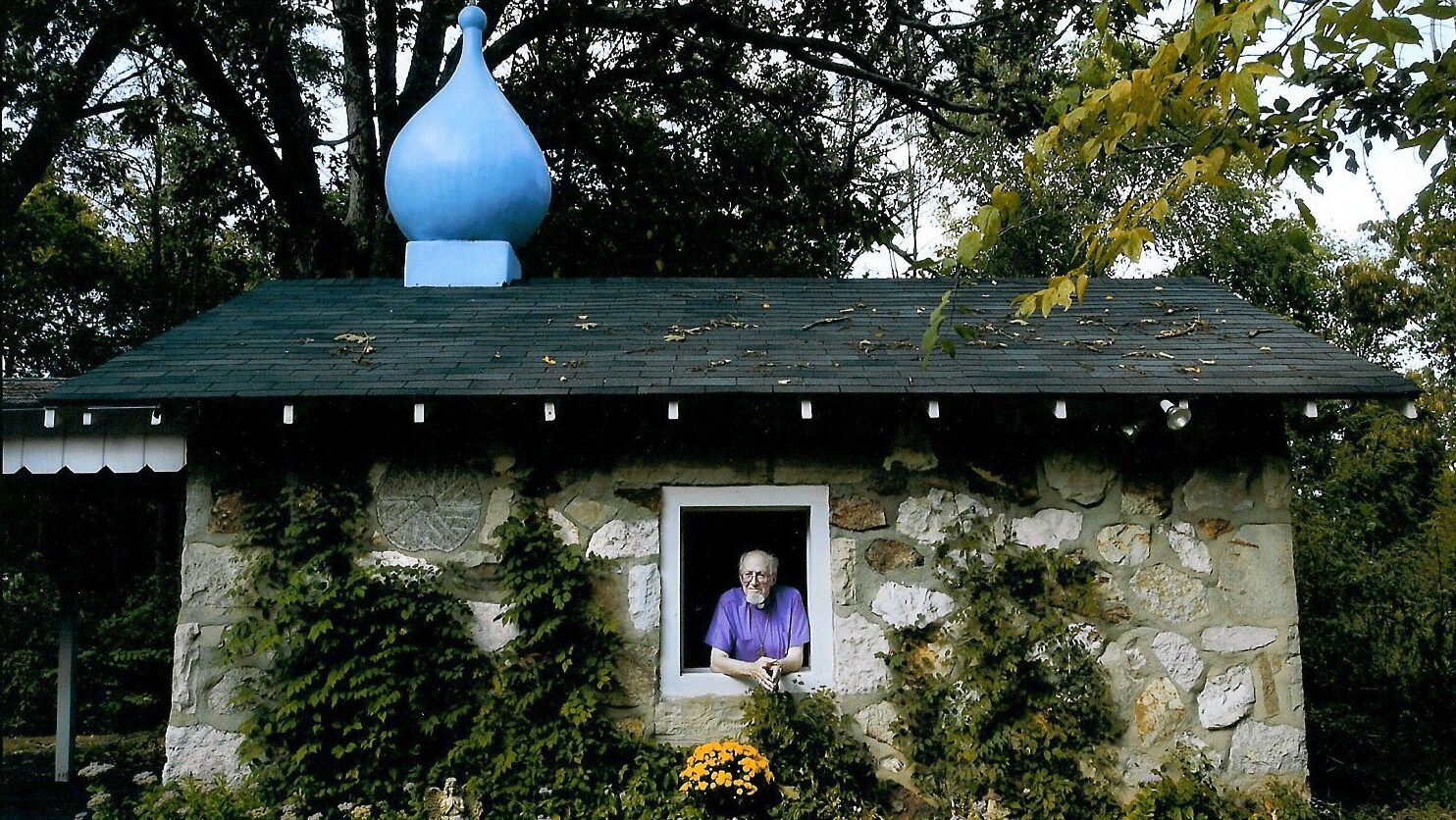
In 1983 Bishop Karl relocated to Highlandville, Missouri where he built the Cathedral of the Prince of Peace, a small stone building adorned by a blue onion cupola. The following year the “Guinness Book of World Records” designated it as the “World’s Smallest Cathedral” and visitors began coming from all parts of the world to visit it and some to attend Mass or to offer a prayer for peace. The town is situated almost in the geographic center of the nation and Bishop Karl found it easier to reach out and consequently new parishes were established in new areas. Parishes were eventually established in Columbus, Deming and Las Cruces, New Mexico. In Highlandville, Missouri a Garden of the Saints was established next to the Cathedral.
In central Illinois Fr. Robert Brouillette had a vital nursing home ministry, with services at a home in Shelbyville and a Bible class in LeRoy. Fr. David Ellis had a small parish in Mt. Zion, a small community south of Decatur.
CHAPTER FIVE
Christ Catholic Church International
From The Story of Christ Catholic Church (All Five Editions)
In 1989 the Church merged with the Ontario Old Roman Catholic Church. Fr, Fredrick Dunleavy was consecrated Archbishop to succeed Archbishop Nelson Hillyer who had served in that capacity since 1965. The Ontario Old Roman Catholic Church was founded by Bishop William Pavlik who had formerly been with Bishop Richard Marchenna. Bp. Pavlik came to Canada on behalf of the Old Roman Catholic Church and served for a while in the newly created Diocese of Ontario. In 1963 he separated from Bp. Marchenna and named his new jurisdiction, “The Old Roman Catholic Church of Ontario.” The new church worked with the poor in the inner city of Toronto and had a visible and appreciated apostolate of social services. The ORCCO maintained a food pantry and brought together many of Toronto’s poor into a caring and supportive community. Even today St. Andrew’s parish ministers largely to the poor, although many of its members have come out of poverty and their children even their grandchildren, attend the Church as sponsoring members. Among the present members of St. Andrew’s is Bishop Hillyer’s son.
At the death of Bp. Hillyer in 1987 the Church turned to Christ Catholic Church for the consecration of their newly elected bishop, Fr. Fredrick Dunleavy. They also decided to enter into union with Christ Catholic Church to end their isolation. The Old Roman Catholic Church of Ontario had two other parishes in addition to St. Andrews, one in Niagara Falls, New York and another in Erie Pennsylvania. Eventually these left and the Toronto parish felt the need for fellowship of other congregations. The union came together largely on mutual faith with few written documents and Bishop Karl Prüter was accepted as Presiding Bishop, although there was never a formal vote.
At a Church Synod that met in Republic, Missouri in 1989, Bishop Karl Prüter resigned as Presiding Bishop in order to devote more time to the Cathedral Church. At that time Bishop Dunleavy was elected as Presiding Bishop with the title of Archbishop. The formal elevation took place on June 18, 1991. At the elevation, Archbishop Fredreick of conversations he was having, on behalf of Christ Catholic Church, with Archbishop Donald Mullan of the Liberal Catholic Church of Ontario and indicated that the union of the two bodies seemed possible and desirable. Bishop Karl then visited Bishop Mullen at Niagara Falls and found himself enthusiastic about the possible union of the two churches. At another visit attended by the clergy of the Liberal Catholic Church and Bishop Prüter it was decided to take the necessary steps to unite the two bodies. Archbishop Dunleavy was not present at the meetings but instructed Bishop Karl to represent him and Christ Catholic Church. At the meeting it was decided to poll the clergy and the parishes of both denominations as to whether they favored the union. The vote to unite was favorable. The next step was to vote on the choice of a Presiding Bishop. A vote was taken and Archbishop Donald Mullan was elected. It had been further agreed that the new church body would be known as Christ Catholic Church, on both sides of the border.
It was a union that was not “made in heaven,” for although it had been assumed that both churches had the same polity, theology, and that their approach to worship were similar, it was soon discovered that this was not so. Although only one parish in Canada was tainted with theosophy most of the others were very Protestant in the approach t worship. In matters of worship most of the parishes that came from the Liberal Catholic Church of Ontario used eclectic Mass, which included portions from the Anglican Rite and from the Novus Ordo. Hymns and music tended towards fundamentalist Protestantism.
Theologically the Christ Catholic Churches south of the border grew uneasy over the uncertain trumpet that was being sounded by the new Christ Catholic parishes, and urged Bishop Karl to separate from Archbishop Mullan and the parishes that came with him. The separation was made on November 24, 1995 when Archbishop Karl sent a letter to Archbishop Donald Mullan informing him that Christ Catholic Church could no longer be a part of Christ Catholic Church International, the merger had lasted just three short years. Bishop Karl felt certain that almost all the parishes and priests from the original Christ Catholic Church would support his Episcopal action. He was not only correct in his assumption, but one of the priests who had left because of the union returned to the fold.
The reorganized Church entered 1996 with ten parishes and ten priests in the United States, Canada, and Australia. In addition it continued to publish the St. Willibrord Journal, which under the editorship of Father Charles Harrison has for over a decade given a clear Catholic witness and is circulated through the Independent Catholic and Orthodox Community,
The growth of Christ Catholic Church was slow after the separation from Christ Catholic Church International but they felt stronger than before. Fr. John Havens continued with Bishop Prüter and began a mission in Killeen, Texas. In 2002 Christ Catholic Church received a parish in Oakland, California that had asked for a priest a decade earlier. At that time the jurisdiction had been unable to send anyone although Bishop Karl had celebrated Mass a few times with this budding parish when we was in the Bay Area. At this time, John Marquette in whose home the group had met was willing to step forward and receive Holy Orders. He was ordained and served the congregation as pastor.
Christ Catholic Church at the Cathedral of the Prince of Peace in the Ozarks continued to grow and would soon outpace the growth of the church at large. Holy Mass was held daily in “The World’s Smallest Cathedral” and work went on within St. Willibrord Press and through Bishop Karl’s outreach to the community.
Chapter Six
The Path of the Shepherd’s Heart
Before Brother Brian Brown ever stepped through the doors of the Cathedral of the Prince of Peace, before he met Bishop Karl Prüter, and before he knew the deeper history of Christ Catholic Church, another path had already begun to shape his vocation.
That path was Celtic, monastic, sacramental, and deeply pastoral.
Brian’s journey toward Holy Orders did not begin with ambition for title or office. It began with a hunger for a form of Christian life that felt ancient and alive, rooted and free, catholic and spacious enough to hold both tradition and the wild breath of the Spirit. He had begun his formal discernment within the Episcopal Church and had completed his first year of seminary when he began to sense that his calling might lead him beyond the boundaries he had first expected.
He loved the Episcopal Church and remained grateful for what it had given him. Yet somewhere within the deeper chambers of the soul, he knew that the path unfolding before him was not quite the one he had imagined. There was a different road calling, though he did not yet know its name.
Drawn especially to Celtic Christianity, Brian began searching for the old wells: the saints of the islands, the rhythm of prayer and pilgrimage, the nearness of creation, the kinship of humans and animals, and the thin places where heaven and earth seem to breathe through one another. In that search, he discovered the Autocephalous Sacramental Movement, a world of independent sacramental communities, wandering bishops, small jurisdictions, monastic experiments, and churches living outside the large institutional structures of Rome, Canterbury, and Constantinople.
It was a strange world, to be sure. It was not always tidy. It was not always easy to explain. But within it Brian found something that resonated with his own emerging vocation: the possibility of a sacramental Christian life that could be both catholic and free.
In 2000, Brian began his ministry within the Celtic Catholic Church, Diocese of Saint Brendan, headquartered in Southern California. He studied with Bishop Dwain Houser at St. Columba’s School of Theology and began to receive formation in a distinctly Celtic Catholic expression of the sacramental life. In time, he was tonsured and entered Minor Orders within that tradition.
Tonsure marked something important. It was not ordination to the priesthood, nor was it merely ceremonial. It was a sign of belonging to a way of life. It set him apart not above others, but toward service, prayer, and spiritual discipline. It marked him as a “slave of Christ” and became the beginning of a more consciously monastic and ecclesial vocation.
He was then sent out to form a mission station for the people of the Ozarks.
On an Easter morning shortly after his tonsure, Brother Brian began Saint Melangell’s Celtic Catholic Mission Station. That beginning would shape him profoundly. Saint Melangell, the Welsh saint associated with sanctuary, mercy, and the protection of the vulnerable, would become more than a patron of a mission. She would become a sign of the kind of ministry Brian was being called to embody.
Saint Melangell’s Mission was not grand. It was not impressive by worldly standards. But it was real. It was local, relational, and rooted in the lives of ordinary people. It taught Brian that church was not first of all a building, a bureaucracy, or a brand. Church was a gathered people seeking Christ. Church was prayer around a table. Church was sanctuary offered to the wounded. Church was the Gospel becoming flesh in a particular place.
During this same season, Brian also took vows in the Community of the Companions of God, an ecumenical religious order sponsored by the Celtic Catholic Church. These vows deepened the monastic character of his vocation. The Companions of God offered a pattern of prayer, service, community, and common discipline. It gave language and structure to what had already begun stirring within him: the desire to live Christianity not merely as belief, but as a way of life.
For three formative years, Brian served within this Celtic Catholic setting, studying, praying, learning, and putting faith into practice. The roots went deep. His love of Celtic Christianity, new monastic life, sacramental worship, and pastoral ministry did not begin later with Christ Catholic Church. They were already growing here.
Yet as sometimes happens in ministry, a difference in vision eventually became clear. By 2003, Brother Brian came to understand that his own path and the path of the Celtic Catholic Church were no longer moving in precisely the same direction. He left that jurisdiction, but he did not leave behind his love for Celtic Christianity, nor his affection for the people and the spiritual inheritance he had received there.
The local community that had formed around him faced its own question: what now?
They had prayed together, served together, and been shaped by a shared Common Rule. They had become more than a temporary project. They had become a spiritual family. Rather than dissolve, the community chose to remain together. They continued the same prayers, traditions, practices, and liturgical rhythms that had formed them. They continued to be, in spirit and practice, the Chapter of the Community of the Companions of God they had grown to be.
But they needed a new ecclesial home.
In 2003, seeking a more inclusive church body with which to affiliate the Community of the Companions of God, Brother Brian began ministry with the United Catholic Church. The United Catholic Church offered something he and the Companions needed at that moment: room to breathe. It provided a loose but meaningful structure, a sense of family, and a spirit of peace, inclusivity, honesty, and love. It seemed, at the time, a providential match.
Bishop Lawrence Michael Cameron, OAC, a bishop in the United Catholic Church and Abbot of the Order of the Anamcara, agreed to serve as Episcopal Visitor for the newly chartered Community of the Companions of God. This provided the community with episcopal care and a recognized place within the sacramental life of the wider Church.
Brother Brian had already been elected by the Companions during their General Chapter to serve as interim abbot and spokesperson until a formal charter could be received. Once that charter was accepted by the United Catholic Church and by the Companions themselves, the community reconvened and elected him Abbot General.
In 2004, while serving in the United Catholic Church, Brother Brian first visited the Cathedral of the Prince of Peace in Highlandville, Missouri, known affectionately as the World’s Smallest Cathedral. There he met Archbishop Karl Prüter, began learning more about Christ Catholic Church, and gradually found himself drawn back for worship, conversation, and simple acts of service around the Cathedral and its strolling five acres. This first meeting did not yet mark a transition into Christ Catholic Church, but it opened a door of friendship, curiosity, and spiritual kinship that would grow in importance over the years ahead.
On October 16, 2004, the Feast of Saint Gall, Brother Brian was ordained to the Holy Order of Deacons within the United Catholic Church in Toledo, Ohio. On that same occasion, Bishop Lawrence Michael Cameron gave him the abbatial blessing to serve the Community of the Companions of God as a mitred abbot.
This was a significant moment in Brian’s vocation. The diaconate confirmed his call to service: to the altar, to the Gospel, to the poor, to the broken, and to the needs of the gathered community. The abbatial blessing confirmed his call to spiritual leadership within a religious community. He was not merely being prepared for priestly ministry in the abstract. He was being shaped as a pastor, monastic superior, and servant of a particular people.
The following year, on May 27, 2005, the Feast of Saint Melangell, Deacon Brian was ordained to the Holy Priesthood by Archbishop Robert M. Bowman and Bishop Lawrence Michael Cameron, OAC, of the United Catholic Church. The ordination took place at Shepherd of the Hills Episcopal Church in Branson, Missouri, surrounded by friends, family, and Companions from across the country.
That date mattered. Saint Melangell had been the patron of his first mission. Her feast day bound together the beginning of his pastoral ministry and the fullness of his priestly ordination. The saint of sanctuary stood as a quiet witness over the altar.
Brian’s priesthood would be shaped by that same spirit: sanctuary, mercy, healing, and welcome.
Later in 2005, as the community continued to mature, it became clear that the name Community of the Companions of God might cause confusion with the original community in the Celtic Catholic Church, with whom they shared a genuine history. With the encouragement of their abbot, the community chose to clarify and broaden its identity. The Order of the Shepherd’s Heart was born.
That name reflected the pastoral heart of the community’s vocation. It suggested care, guidance, compassion, and the willingness to seek the lost and tend the wounded. It also pointed toward what would become an enduring theme in Brian’s ministry: the Cure of Souls.
That same year, on the Feast of Saint Willibrord, members of the United Catholic Church in the Ozark Mountains formed the Diocese of Saint Willibrord in the Ozarks. The diocese was named in recognition of their growing association with Christ Catholic Church, Archbishop Karl Prüter, and their shared Old Catholic roots. Father Abbot Brian was elected Diocesan Bishop-Elect and appointed Apostolic Administrator by Archbishop Robert Bowman until his consecration could take place. The proposed consecration was approved by the appropriate houses of the United Catholic Church.
As so often happens in the Independent Sacramental world, differences in vision, practice, and policy led to division. In the spring of 2006, before Bishop-Elect Brian’s consecration could take place within the United Catholic Church, three dioceses separated from that jurisdiction, including the Diocese of Saint Willibrord in the Ozarks. Seeking a different way of being church, one marked by radical inclusion and rooted in the Ozarks, the diocese dissolved. Its members no longer continued under the United Catholic Church, and the community began moving toward a new and more autonomous expression of sacramental life.
On the Feast of Saint Kevin, June 3, 2006, Father Abbot Brian, with the consent, support, and prayers of Bishop Lawrence Michael Cameron and Archbishop Karl Prüter, was consecrated to the Office of Bishop by Bishop Rodney Rickard, a bishop of the United Catholic Church. Though Father Abbot Brian and the community had already parted ways with the United Catholic Church because of differences in ministry, vision, and full inclusion, the consecration itself remained a sacramental act of continuity, blessing, and transition.
At that consecration, Bishop Brian was given charge over the newly autocephalous and autonomous jurisdiction of the Ecumenical Free Catholic Communion. This moment marked a significant turning point in his vocation. The path that had begun in Celtic Catholic formation, taken root in vows and monastic community, and deepened through the diaconate, abbatial blessing, and priesthood, now widened into episcopal ministry.
The Ecumenical Free Catholic Communion was born not as an act of ambition, but as an effort to give shelter and sacramental structure to a community committed to radical hospitality, generous orthodoxy, and the full inclusion of those too often wounded or excluded by the Church. It sought to carry forward the Free Catholic spirit in a new way: Christ-centered, sacramental, ecumenical, inclusive, and rooted in the living Gospel.
This consecration also formed an important bridge between the earlier United Catholic chapter of Bishop Brian’s ministry and the Christ Catholic legacy that would soon be entrusted to him more fully through Archbishop Karl Prüter. Though the formal relationship with the United Catholic Church had ended, the grace received through that season remained part of the story. Nothing was wasted. The vows, the orders, the friendships, the conflicts, and the departures all became part of the road.
By the summer of 2006, Bishop Brian’s vocation had taken on a clearer shape. He was no longer only a monastic priest and abbot shepherding a small community. He had become a bishop charged with guarding an independent sacramental communion, one that would eventually evolve into the Sacramental Community of the Coworkers of Christ.
By the time Bishop Brian’s relationship with Archbishop Karl Prüter and Christ Catholic Church deepened in the years that followed, his own vocation had already been richly formed. He had been tonsured in the Celtic Catholic tradition. He had taken vows among the Companions of God. He had founded a mission under the patronage of Saint Melangell. He had served within the United Catholic Church, been ordained deacon, blessed as mitred abbot, and ordained priest. He had shepherded a small religious community through transition, continuity, and rebirth. He had met Archbishop Karl and begun to learn from the living witness of the Cathedral of the Prince of Peace, even before Christ Catholic Church became the central ecclesial inheritance entrusted to his care.
But in hindsight, the journey was clear.
The Celtic path, the monastic vows, the mission in the Ozarks, the Companions of God, the United Catholic Church, the diaconate, the abbatial blessing, the priesthood, the Order of the Shepherd’s Heart, the Diocese of Saint Willibrord in the Ozarks, and the birth of the Ecumenical Free Catholic Communion were all preparing him for what would come next.
Before he inherited the Christ Catholic legacy, he had already become a pilgrim of the Gospel.
Before the World’s Smallest Cathedral became part of his own ministry, he had already learned that small things can carry great grace.
And before he fully understood what it would mean to carry the Christ Catholic witness forward, he had already begun to live its deepest truth:
Jesus cares. Christ is the center. The Gospel is the way.
CHAPTER SEVEN
From Successor to Steward: The Living Christ Catholic Legacy
The story of Abbot-Bishop Brian Ernest Brown’s tenure as Archbishop of Christ Catholic Church, Archdiocese of the Prince of Peace, cannot be told merely as a matter of ecclesiastical office. It is not simply a record of dates, titles, documents, or jurisdictional succession. At its heart, it is a story of friendship, promise, grief, continuity, and transformation.
It is the story of a younger cleric who found in Archbishop Karl Hugo Rehling Prüter not only a mentor, but a spiritual elder, a fellow pilgrim, and a living witness to the strange, small, stubborn beauty of the Christ Catholic way.
Brian first came to know Archbishop Prüter through the Cathedral of the Prince of Peace in Highlandville, Missouri, affectionately remembered by many as the “World’s Smallest Cathedral.” The little stone chapel, crowned with its Bavarian blue cupola, was more than a curiosity. It was a sign. Small in size but large in witness, it stood as a living icon of Archbishop Prüter’s ministry: humble, unconventional, sacramental, peaceful, and deeply rooted in Christ.
In Archbishop Prüter, Brian encountered a kindred spirit. They were not identical men. They differed in generation, temperament, and sometimes theology. Archbishop Karl often represented a more conservative orthodoxy, while Brian was increasingly drawn toward what he would later describe as a more generous orthodoxy — sacramental, inclusive, contemplative, and ecumenical. Yet beneath their differences was a shared love of Christ, the Eucharist, mysticism, monastic life, church history, liturgy, publishing, and the work of peace.
Their relationship grew through shared ministry. Brian served as Chaplain to the Cathedral of the Prince of Peace and as a member of the Cathedral Chapter. He worked alongside Archbishop Prüter in the ministry of St. Willibrord Press, assisting with proofreading, printing, distribution, online bookselling, and the preservation of Old Catholic and Independent Sacramental writings. Their friendship was practical as well as spiritual: part theology, part printing press, part pastoral care, part laughter, part exasperation over computers, which Archbishop Prüter famously regarded as “tools of the devil.”
Bishop Karl Prüter also helped inspire and shape the formation of the Ecumenical Free Catholic Communion, of which Christ Catholic Church was a founding member. The EFCC emerged not as a traditional jurisdiction or denomination, but as a fellowship of independent sacramental communities seeking communion without absorption. Its purpose was to provide a place of shared ministry, mutual encouragement, and sacramental fellowship for communities that wished to walk together while preserving their own identity, polity, customs, and traditions. In this way, the Ecumenical Free Catholic Communion reflected something of Bishop Karl’s own Free Catholic spirit: catholic without being controlling, sacramental without being rigid, and committed to unity without demanding uniformity.
Over time, Archbishop Prüter began to see in Brian the person who might carry his ministry forward. This was not a casual matter. Christ Catholic Church had already endured many attempts by others to claim, reshape, or use its name and inheritance. Because of its historic significance within the Old Catholic, Free Catholic, and Independent Sacramental movements, the name “Christ Catholic Church” attracted people who sometimes wanted the legacy more than the labor, the title more than the responsibility, the shell more than the spirit.
Brian understood this danger. He had seen enough of the Independent Sacramental world to know that names, lines of succession, and ecclesiastical claims can become empty if severed from integrity, formation, and real pastoral service. For that reason, when Archbishop Karl asked him more than once to assume greater leadership, Brian hesitated. His hesitation was not a lack of love. It was reverence. He did not want to inherit Christ Catholic Church only to fracture his relationship with Karl or betray his own conscience on questions of inclusion, women in ministry, and the full dignity of LGBTQ+ persons in the life of the Church.
Those differences were real. They mattered. Yet they did not have the final word.
As Archbishop Prüter’s health declined, the question of succession became unavoidable. He and his wife, Teresa, prepared to leave the Ozarks and move to Colorado to be closer to family. Before leaving, Archbishop Karl entrusted Brian with the ministry of the Cathedral of the Prince of Peace and the continuing Christ Catholic witness associated with it. On September 9, 2007, the Feast of Saint Ciaran of Clonmacnoise, Archbishop Prüter sub-conditionally consecrated Bishop Brian Brown at the Cathedral of the Prince of Peace and placed under his care the episcopal protection and oversight of Christ Catholic Church, Archdiocese of the Prince of Peace.
This entrustment was both sacramental and deeply personal.
Archbishop Prüter gave Brian the antimension he had received from Archbishop Peter A. Zhurawetsky at his own consecration. He entrusted to him much of the work of St. Willibrord Press, many of his books, papers, vestments, and personal effects. Brian promised to continue the ministry for as long as he was able.
Two months later, on November 18, 2007, Archbishop Karl Prüter died peacefully in Colorado with Teresa by his side, reading Psalm 23 and holding his hand.
Brian conducted Archbishop Prüter’s memorial service at the Cathedral of the Prince of Peace. It was an act of grief, gratitude, and fidelity. In that moment, the promise became more than words. The younger bishop had become the keeper of a flame.
As Archbishop of Christ Catholic Church, Archdiocese of the Prince of Peace, Brian’s tenure was never about building a large institution. It was about preserving a living trust. He continued the sacramental ministry of the Cathedral as long as circumstances allowed, offering Mass there until the property was later turned into a commercial wedding chapel. He carried forward the work of St. Willibrord Press and preserved Archbishop Prüter’s writings and historical witness. He held together memory, lineage, pastoral responsibility, and spiritual continuity during a fragile transition.
His leadership was custodial, but not static.
Brian did not understand his task as embalming the past. He understood it as carrying forward the Christ Catholic charism into a new season. That charism was never merely a jurisdictional identity. At its best, Christ Catholic meant exactly what the name declares: a catholic faith centered in Christ. Sacramental, yes. Historical, yes. Independent, yes. But above all, Christ-centered.
In time, Brian’s own vocation continued to deepen and change. In 2018, he stepped down from active leadership of Christ Catholic Church to embrace a more nomadic, monastic, and contemplative path. This was not an abandonment of the Christ Catholic legacy. It was part of its transformation. During that season, he traveled widely, finding inspiration in the stark beauty of the desert and in the rainforests and waterways of the Pacific Northwest. Like the hermits of old, he spent time in solitude, prayer, study, and interior reckoning, immersing himself more deeply in mysticism, sacramental theology, liberation theology, and the ancient Christian discipline of the Cure of Souls.
That contemplative passage helped clarify the next expression of the work.
The Ecumenical Free Catholic Communion, founded in 2006, eventually evolved in 2023 into the Sacramental Community of the Coworkers of Christ — a new-monastic, emerging-church community devoted to an inclusive, ecumenical, and contemplative Christian life. In that community, the Christ Catholic inheritance did not disappear. It ripened.
Today, Brian lives into the role of Archbishop Emeritus not as a retired ecclesiastical monarch, but as an elder, steward, teacher, and keeper of memory. His emeritus role is not about holding power. It is about bearing witness. It is about guarding the story without clutching the reins. It is about blessing the next expression of the work while honoring the hands that first entrusted it to him.
As Archbishop Emeritus, Brian continues to embody the Christ Catholic legacy through the Sacramental Community of the Coworkers of Christ. He remains a Christ Catholic because he remains centered in Christ. He understands the Coworkers of Christ as Christ Catholics in the deepest sense: not as claimants to a contested name, but as heirs of a spiritual vocation.
The Coworkers carry forward Archbishop Karl Prüter’s legacy not by preserving an institutional shell for its own sake, but by keeping alive its inner fire: sacramental worship, Christ-centered faith, peace witness, theological curiosity, pastoral care, publishing, spiritual formation, and welcome to those searching for a more merciful expression of Catholic Christianity.
The title Archbishop Emeritus, then, is not merely honorary. It names a particular spiritual task.
To remember without becoming trapped in nostalgia.
To preserve without freezing.
To teach without dominating.
To bless without needing control.
To carry the grief of what has passed while midwifing what is still being born.
Brian’s tenure as Archbishop of Christ Catholic Church, Archdiocese of the Prince of Peace, was the fulfillment of a promise made to Archbishop Karl Prüter: that his ministry would not be allowed to die. That promise is still being kept. Not always in the forms anyone might have expected. Not always under the old structures. Not always in the language of jurisdiction and office.
But the flame remains.
It burns now in the Coworkers of Christ, in the Common Rule, in the Daily Round, in the Cure of Souls, in Christ Catholic reflection and teaching, in the continued preservation of Archbishop Prüter’s memory, and in the simple confession that stands at the heart of it all:
Jesus cares. Christ is the center. The Gospel is the way.