

Jesus Christ Cares: Why Care May Be the Word Our Wounded World Can Still Understand
The ancient Orthodox proclamation IC XC NIKA means, “Jesus Christ conquers.” I understand why the Church latched onto that phrase. It is a powerful confession. It proclaims that Jesus Christ conquers sin, death, hell, and the grave. It declares that the crucified and risen Lord is victorious, not in theory, not as a slogan, but in the deepest fabric of reality. Death has been trampled down. The tomb has been emptied. The powers of darkness don’t get the final word.
And yet, in our own time, the word conquers can be difficult for many wounded souls to hear. Not because the theology is false. It’s true. But because so many people have already been conquered by too much. They’ve been conquered by grief, loneliness, poverty, addiction, shame, bad religion, family wounds, political cruelty, and churches that spoke often of love but didn’t seem to know how to practice it.
For many people, the language of conquest has been stained by domination. They’ve known conquest as force, control, manipulation, exclusion, humiliation, and power dressed up in holy words. So even when Christians speak rightly of Christ’s victory, the wounded heart may still flinch.
That’s why the Christ Catholic proclamation Jesus Christ Cares matters so deeply to me. It doesn’t deny that Christ conquers. It reveals how Christ conquers. Christ conquers because Christ cares. He conquers death by entering it. He conquers hatred by forgiving. He conquers sin by healing the sinner. He conquers alienation by gathering the scattered. He conquers fear by breathing peace. He conquers despair by standing alive outside the tomb. The world understands conquest through force. Christ reveals conquest through care. And that isn’t weakness. That is the Gospel.
Christians speak often of love, and rightly so. “God is love,” says Saint John. Jesus gives us the great commandments: love God and love your neighbor. He tells his disciples that they’ll be known by their love. But in our culture, the word love has been stretched thin. It’s been romanticized, commercialized, sentimentalized, weaponized, and emptied of meaning. People say they love pizza, love their favorite show, love their spouse, love their country, love God, love their neighbor, and sometimes love the very systems that crush their neighbor.
The word is everywhere, and because it’s everywhere, many no longer know what it means. Some people don’t even believe in love anymore. Not really. They’ve heard the word too many times from people who left, betrayed, abused, ignored, manipulated, or abandoned them. But most people still understand care.
Care is harder to fake. Care is concrete. Care shows up. Care feeds the dog. Care brings soup. Care answers the phone. Care sits beside the hospital bed. Care remembers the anniversary of grief. Care notices who’s missing. Care tells the truth gently. Care makes room. Care stays.
Care is love with hands. Care is love with a towel and basin. Care is love that has stopped making speeches and started washing feet. In a world where “love” is often misunderstood, care may be one of the clearest doors back into love.
The Gospels are full of the care of Christ. Jesus sees the crowds and has compassion on them because they’re harassed and helpless, like sheep without a shepherd. He feeds the hungry. He touches lepers. He blesses children. He restores sight. He listens to the desperate. He defends the accused. He welcomes the excluded. He forgives sinners. He weeps at the tomb of Lazarus. He speaks peace to frightened disciples hiding behind locked doors.
This isn’t vague benevolence. It is personal, embodied, attentive care. Jesus doesn’t love humanity as an abstraction. He loves actual people: hungry people, sick people, grieving people, difficult people, religious people, irreligious people, faithful people, failing people, people who can’t get their lives together, people who’ve been cast aside, people who’ve wandered far from home. He loves the one in front of him. That’s the pattern.
When Jesus asks, “What do you want me to do for you?” he reveals the attentiveness of divine care. He doesn’t reduce people to causes, projects, diagnoses, or moral failures. He sees them. He hears them. He calls them by name.
This is the Christ at the center of a Christ Catholic faith. Not Christ as a mascot for an institution. Not Christ as a chaplain of the empire. Not Christ as a weapon in the hands of the self-righteous. Not Christ as a cold judge standing far off with folded arms. Christ the Good Shepherd. Christ the healer. Christ the friend of sinners. Christ who cares.
Of course, there’s a danger in misunderstanding care as softness without truth. That is not the care of Christ. Christ’s care is tender, but it isn’t timid. He confronts hypocrisy. He challenges the powerful. He overturns tables. He warns false shepherds. He calls people to repentance. He tells the rich young ruler to let go of what owns him. He tells the woman caught in sin, “Go, and sin no more,” but only after refusing to let the mob destroy her.
Christ’s care doesn’t flatter people into ruin. It heals. Real care tells the truth, but it doesn’t use truth as a club. Real care protects the vulnerable, but it doesn’t abandon the offender to their own darkness. Real care names harm, but it doesn’t delight in punishment. Real care seeks restoration wherever restoration is possible.
Care has backbone. Care can say no. Care can draw boundaries. Care can rebuke wolves and still go searching for wounded sheep. So when I say Jesus Christ cares, I’m not saying Jesus is merely nice. I’m saying that the heart of God revealed in Christ is merciful, attentive, healing, courageous, and faithful. That kind of care can save a life. That kind of care can save a soul.
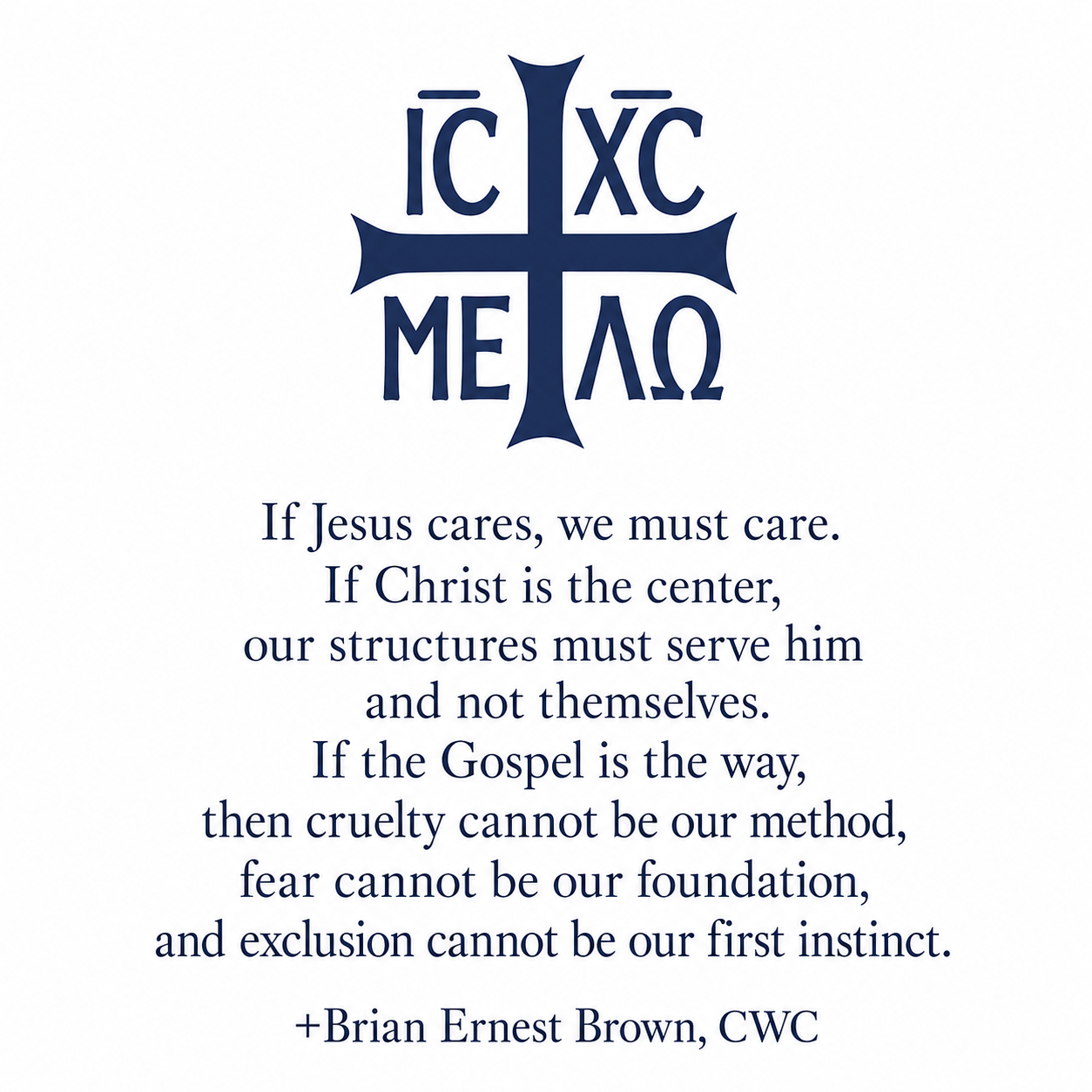
The Christ Catholic emblem, patterned after the Orthodox IC XC NIKA, places this proclamation around the cross: Jesus Christ Cares. That matters because Christian care is cruciform. It is shaped by the Cross. The care of Christ is not distant pity. It is not divine sympathy from a safe height. In Jesus, God comes near enough to suffer with us and for us. The Word becomes flesh. Christ enters hunger, grief, betrayal, abandonment, violence, humiliation, and death.
The Cross tells us that God’s care is not theoretical. God bleeds. God enters the wound. God doesn’t rescue the world by remaining untouched by it. This is why care is not secondary to Christian faith. It is central. The Cross is the supreme revelation of divine care. There, Christ stretches out his arms not to dominate the world, but to embrace it in mercy.
And the resurrection doesn’t erase that care. The risen Christ still bears wounds. That should tell us something. Even victory is wounded. Even glory remembers suffering. Even resurrection doesn’t despise the body that endured the pain.
Here is the hard edge of the phrase: if Jesus Christ cares, then the Church must care. If the Church doesn’t care, it has lost contact with Christ, no matter how correct its doctrine, how ancient its liturgy, how valid its orders, or how beautiful its vestments.
This is where the phrase becomes judgment. It judges every cold altar, every cruel sermon, every gatekeeping table, every bishop who feeds on the flock, every priest who forgets the wounded, every church that protects reputation over people, every community that confuses control with holiness, and every Christian who says “Lord, Lord” while stepping over the neighbor in the ditch.
The care of Christ is the measure of Christian ministry. Do we care for the poor? Do we care for the sick? Do we care for the grieving? Do we care for those wounded by religion? Do we care for LGBTQ+ persons cast aside by churches? Do we care for prisoners, immigrants, addicts, elders, children, and the unhoused? Do we care for creation and the creatures entrusted to us? Do we care for those who disagree with us? Do we care enough to listen? Do we care enough to repent? These are not decorative questions. They are Gospel questions.
The Church exists to make the care of Christ visible, tangible, and trustworthy. Bread in the hand. Wine in the cup. Water on the brow. Oil on the sick. A blessing over the grieving. A place at the table. A shepherd searching for the one who wandered. That is sacramental care. That is the Cure of Souls.
To be Christ Catholic, as I understand it, is to place Christ at the center of catholic faith and practice. Not Rome. Not Canterbury. Not Utrecht. Not denomination. Not jurisdiction. Not ideology. Not even a beloved tradition. Christ.
This doesn’t mean tradition is discarded. Far from it. I honor the sacraments, the liturgy, the saints, the mystics, the Scriptures, the ancient faith, the apostolic inheritance, and the long memory of the Church. But all of these must be ordered toward the living Christ.
Tradition without Christ becomes nostalgia. Authority without Christ becomes control. Doctrine without Christ becomes a weapon. Sacrament without Christ becomes performance. Catholicity without Christ becomes an empty shell.
The Christ Catholic way insists that all things return to the center: Jesus himself, his words, his mercy, his table, his Cross, his resurrection, and his care. That’s why the confession is so simple: Jesus cares. Christ is the center. The Gospel is the way. It’s not a marketing line. It’s a rule of life.
If Jesus cares, we must care. If Christ is the center, our structures must serve him and not themselves. If the Gospel is the way, then cruelty cannot be our method, fear cannot be our foundation, and exclusion cannot be our first instinct.
Anyone who knows me has heard me say, “People won’t care home much you know, until they know how much you care.”
People are hungry for care. Not vague concern. Not institutional statements. Not religious performance. Real care. They want to know someone sees them. They want to know their grief matters. They want to know their wounds are not inconvenient. They want to know they’re not disposable. They want to know God has not forgotten them.
And many of them are not asking the Church for elaborate theology at first. They’re asking a more basic question: does anyone care?
The answer of the Gospel is yes.
Jesus cares.
And because Jesus cares, we cannot be indifferent. That is the pastoral force of the Christ Catholic emblem. It speaks to the person who has been spiritually conquered enough. It doesn’t come first with threat, argument, or demand. It comes with the quiet strength of the Good Shepherd.
You are seen. You are sought. You are not beyond mercy. You are not outside the reach of Christ.
In the end, Jesus Christ cares does not replace Jesus Christ conquers. It interprets it. Christ conquers through care. Mercy is his victory. Compassion is his power. The Cross is his throne. The empty tomb is his answer. The wounded and risen body is his proclamation.
This is the conquest the world doesn’t understand and desperately needs. Christ does not conquer by becoming what we fear. Christ conquers by becoming what we need: a shepherd, a healer, a servant, a friend, a savior.
So yes, let the old proclamation stand: Jesus Christ conquers.
And let this Christ Catholic witness rise beside it: Jesus Christ cares.
May the Church learn again what that means. May our sacraments become care. May our theology become care. May our communities become care. May our authority become care. May our lives become care.
And may every wandering, wounded, weary soul who encounters this sign hear beneath it the voice of Christ himself: I see you. I know you. I have not forgotten you.
Jesus cares. Christ is the center. The Gospel is the way.